Decoding Lunar Impact Basins: How Craters Reveal a Planet’s Inner Workings
Impact basins are more than surface scars. They’re archives of planetary history—snapshots of an early solar system shaped by violence, heat, and structural change. On the Moon, these basins dominate the landscape, offering clues not just about impact processes, but about the deep interior conditions that governed their formation.
Our recent work focuses on two enigmatic structures: Hertzsprung and Freundlich-Sharonov. Hertzsprung, the smallest multiring basin on the Moon, contains a central depression and three concentric rings at 256 km, 408 km, and 571 km diameters. Freundlich-Sharonov is slightly smaller but shows a different morphology—a classic peak ring at 200 km, with a broader outer ring at 582 km.
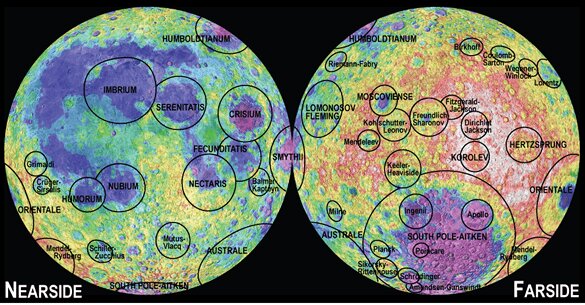
Two Basins, One Puzzle
They’re close in size. They’re close in location. But their internal structures are radically different. That’s not coincidence—it’s data. And it gives us a unique opportunity to test what governs the transition between ring types.
Modeling the Transition
Our models simulate how lunar crustal thickness and thermal gradient shape these basin structures. We’re not just running impacts—we’re mapping the conditions under which energy either rebounds to form a central peak or distributes enough to trigger additional rings.
What we’ve found so far is compelling: crustal thickness appears to be a primary control on whether an impact produces a peak-ring or crosses the threshold into multiring territory. Thermal profile matters too—cooler, thicker crusts tend to yield more complex ringed structures.
From Simulation to Strategy
Understanding these processes isn’t just academic. If we’re going to map the Moon’s geological history—and use it as a reference for other planetary bodies—we need to know what kind of crust we’re dealing with. Impact basins give us a noninvasive probe into the subsurface, and structural variations like these help decode what lies beneath.
We’re also exploring how secondary features—like bench structures and ring faulting—relate to the energy distribution within these basins. That’s where our future work will focus: connecting what we see on the surface to the mechanical story underneath.
Why This Matters
Impact modeling is one of those rare fields where physics, geology, and planetary evolution collide—literally. And by narrowing in on these transitional basins, we’re uncovering a key part of how planetary bodies store, release, and record energy. That matters whether you’re studying the Moon, Mars, or any crust-bearing body in the solar system.
Because when it comes to understanding how planets evolve, the question isn’t just what hit them. It’s how they responded.
Yet for all their visibility, we still don’t fully understand how large basins evolve—especially the transition from peak-ring to multiring structures. These terms aren’t just descriptive; they signal differences in crustal behavior, thermal gradients, and energy dissipation. And if we want to understand how planetary crusts respond to trauma, the Moon is the best lab we have.


