Magnetic fields don’t just happen. They’re born from the deep choreography of a planet’s interior—fluid motions, thermal gradients, structural boundaries—and, sometimes, from external forces that jolt the system into new behavior. Understanding how the Moon generated its ancient magnetic field isn’t just a puzzle about lunar history. It’s a test case for understanding how planetary systems start, sustain, and eventually collapse. And that’s a question that goes far beyond the Moon.
The core question we faced was this: How did the Moon, with its relatively small size and limited internal energy, manage to produce a magnetic field strong enough to rival Earth’s—at least intermittently—for hundreds of millions of years?
Some early theories leaned on core convection. But when we put those models under scrutiny, the numbers didn’t hold. The energy budget didn’t support a sustained dynamo of the strength recorded in the lunar crust. So we asked: what if the lunar dynamo wasn’t steady at all? What if it turned on and off in bursts, driven by external forcing—like mantle precession or orbital interactions—that created temporary episodes of intense magnetic activity?
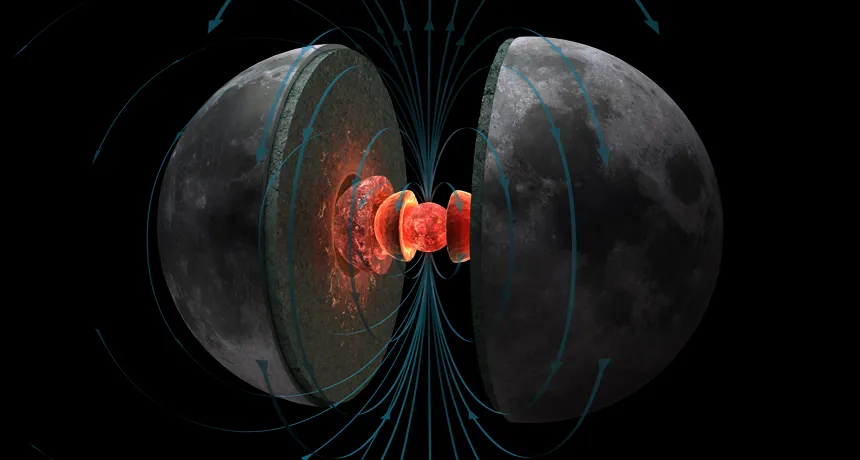
That idea reframes the Moon as a dynamic system, not a slowly cooling rock. It also reframes how we think about other planets and moons. What looks like a weak or absent field might actually be a snapshot—just a quiet phase in a more episodic history. That’s a powerful shift in mindset for how we approach planetary data and what we assume about a system’s potential.
From a systems strategy perspective, the lunar dynamo is a perfect case study in transient resilience: a system that works, but only when conditions align. If you’re building anything—from a research enterprise to a logistics chain—you want to know what forces can temporarily amplify or disrupt performance. And you want to design with that rhythm in mind.
That’s the kind of translation I bring to my work. Whether it’s a research model or an institutional strategy, I’m drawn to the interplay of durability and disruption—the conditions that make a system hold, and the ones that make it fail.
The Moon’s magnetic field might be gone, but the lessons are active. Its history offers insight into how we model incomplete data, test high-stakes assumptions, and rethink what success looks like when energy, time, and bandwidth are limited.
Further Reading:
Lunar Mining for the Next Space Age?
NASA Artemis Science Goals and Lunar Interior
Evans, A. J. & Tikoo, S. M. (2022), An episodic high-intensity lunar core dynamo, Nature Astronomy
Tikoo, S. M. & Evans, A. J. (2022), Dynamos in the Inner Solar System, Annu. Rev. Earth Planet. Sci.


