Kepler’s Legacy: A Galaxy Full of Rocky Worlds
NASA’s Kepler mission revealed a stunning truth: small, rocky planets are everywhere. Many fall between 0.5 and 2 times Earth’s radius, and some orbit in their star’s so-called “habitable zone”—the not-too-hot, not-too-cold region where liquid water could exist. But as scientists (and Earthlings), we now know that orbit alone doesn’t tell the whole story.
A planet’s habitability emerges from the system-level interactions between its interior, atmosphere, surface, and space environment. That’s why we need to move beyond simple checklists—and start thinking like systems scientists.
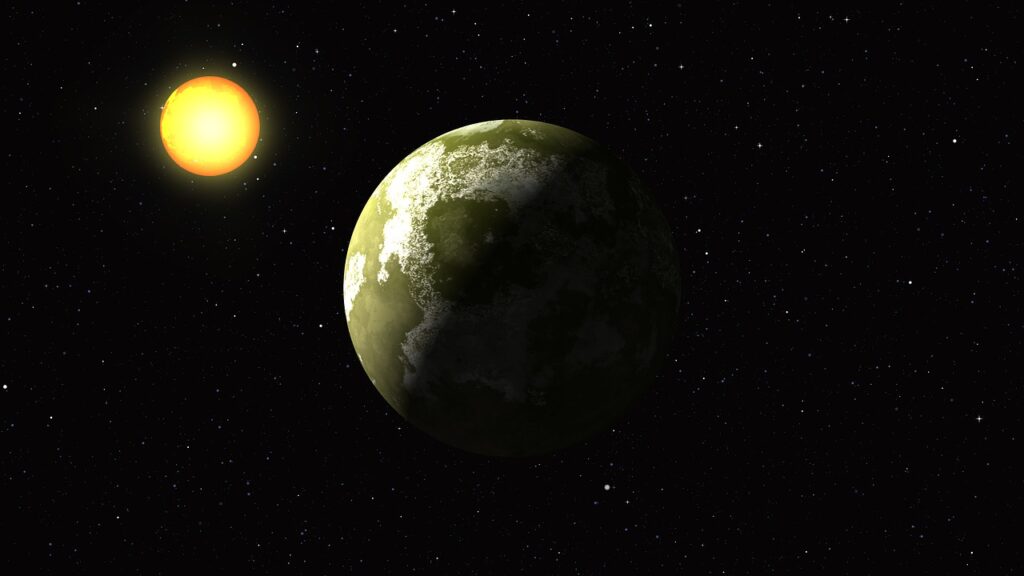
Earth vs. Venus: A Tale of Two Planets
Earth and Venus are similar in size, mass, and composition. Both formed in the same neighborhood of the Solar System. Yet one is a water-rich, life-bearing planet. The other is a superheated inferno with no plate tectonics, no liquid water, and a dense, CO₂-rich atmosphere.
What happened?
Earth’s magnetic field shields its atmosphere from the solar wind. Its plate tectonics regulate carbon and recycle volatiles. Its oceans interact with the crust and atmosphere, stabilizing the climate over geologic time. Venus, by contrast, lacks a magnetic field, has no plate tectonics, and lost its early water—likely to space. These differences cascade across the entire planetary system.
The result? Two planetary histories shaped by interior–atmosphere feedback loops, not just distance from the Sun.
Modeling Habitability from the Inside Out
In our research, we take this systems approach seriously. We model how interior processes—like mantle convection, tectonic mode, and core dynamics—interact with atmospheric evolution and surface temperature over billions of years.
We simulate different tectonic regimes:
- Earth-like mobile lids, where plate tectonics cycles carbon and water
- Mars-like stagnant lids, where heat escapes but tectonics stall
- Heat-pipe worlds, where volcanism dominates the cooling process early on
Each of these internal structures leads to different outgassing rates, magnetic field behavior, and climate feedbacks. And all of them influence whether a planet can hold onto an atmosphere, maintain surface water, and stay habitable over geologic time.
Why Systems Thinking Matters for Exoplanets
When we look at rocky exoplanets, especially those detected by Kepler and TESS, we can’t rely on surface temperature models or orbital position alone. We need integrated models—ones that account for planetary interiors, volatile budgets, magnetic shielding, and atmospheric escape.
This isn’t just about understanding distant worlds. It’s about understanding how unique—or fragile—Earth’s habitability really is. And it’s about building the frameworks we’ll need to interpret the next generation of exoplanet data from JWST, Roman, and beyond.
Further Reading
- NASA Exoplanet Exploration: What is a Habitable Zone?
- NASA Astrobiology: Earth as an Exoplanet
- NASA Venus Fact Sheet
- Early Tectonics at Venus
- Planetary Habitability Laboratory – University of Puerto Rico at Arecibo
- NASA Solar System Exploration: Why Isn’t Venus Habitable?
- NASA Science: How Do Stars and Planets Form?


