Asteroid 16 Psyche has long intrigued scientists as a possible exposed planetary core—a rare window into processes typically hidden deep within terrestrial planets. But recent thinking, including new mission planning and our evolving understanding of metallic volcanism (ferrovolcanism), suggests Psyche may be far more dynamic and complex than once imagined.
Beyond a Static Core
Historically, Psyche was interpreted as the stripped metallic core of a differentiated protoplanet—an object whose rocky mantle had been violently removed. That theory held for decades, grounded in its high radar reflectivity and density estimates. But with new observations and the approaching NASA Psyche mission, the story has started to shift.
For one, Psyche doesn’t have the fully metallic signature we’d expect from a core. Instead, there’s evidence of silicates and regolith, suggesting a more mixed, evolved history. Could it be that Psyche isn’t simply a core, but rather a remnant of complex planetary processes that included partial melting, volcanism, and metallic magmas?
The Case for Ferrovolcanism
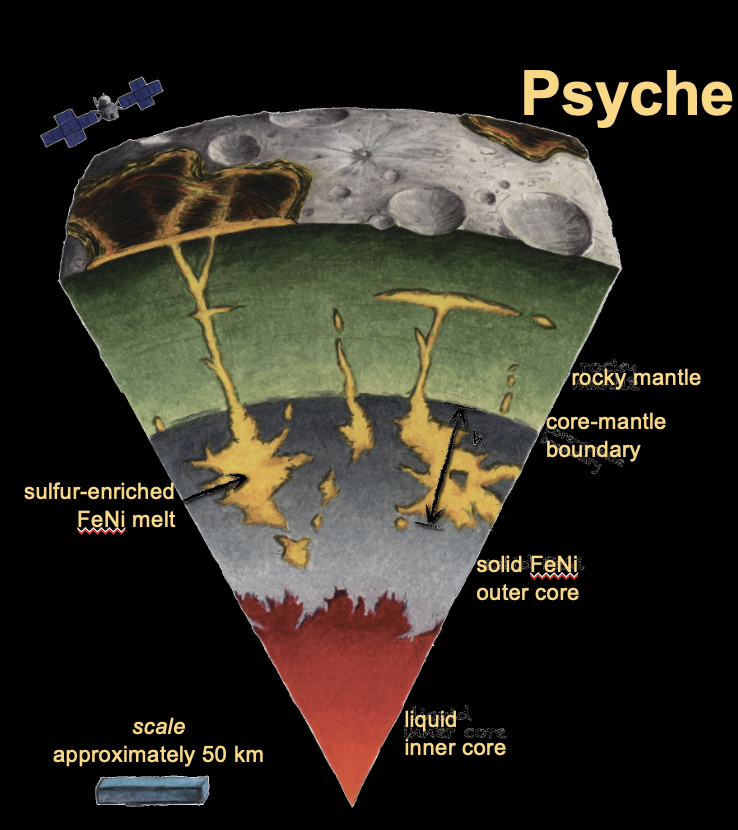
Enter ferrovolcanism—a form of volcanism driven by molten metal instead of silicate rock. If metallic melts segregated in Psyche’s early history, they could have migrated toward the surface through dike-like fractures, erupting in metallic flows. These eruptions would be denser, slower, and visually distinct from anything we know on Earth.
In work I’ve contributed to, we modeled the conditions under which ferrovolcanism might occur, and identified observational signatures—like pitted terrains and low-silicate volcanic textures—that may already be hinted at in telescope data. This process could explain some of Psyche’s unexpected surface features and point to a more active, molten past.
Psyche as a Planetary Experiment
What makes Psyche especially valuable is that it represents a planetary experiment we can’t run anywhere else. The iron-rich bodies in our solar system are mostly buried beneath kilometers of silicates. Psyche—whether core, volcanic remnant, or hybrid—is a testbed for our models of differentiation, core dynamics, and planetary magnetic histories.
It’s also a bridge. Psyche connects the study of small bodies to the big questions about how planets evolve, how magnetic fields are generated, and what happens when bodies melt, segregate, and erupt from the inside out.
As we prepare for data return from the NASA Psyche spacecraft (launched in 2023 and scheduled to arrive in 2029), the next few years will be pivotal. Instruments will search for surface composition, gravity anomalies, and possibly signs of past ferrovolcanic activity.
From Iron Asteroids to Industry Impact
Studying Psyche isn’t just a planetary science exercise. Understanding how metals behave on and below the surface of other bodies has implications for space resource utilization, planetary protection, and mission design for future industrial activities beyond Earth.
When your world is made of metal, everything from geophysics to exploration logistics changes.
Further Reading
- NASA – Psyche Mission Overview
- Nichols‑Fleming, F., Evans, A. J., Johnson, B. C., & Sori, M. M. (2024). “Moment of Inertia and Tectonic Record of Asteroid 16 Psyche May Reveal Interior Structure and Core Solidification Processes.” JGR: Planets.
- Nichols‑Fleming, F., Evans, A. J., Johnson, B. C., & Sori, M. M. (2022). “Porosity Evolution in Metallic Asteroids: Implications for the Origin and Thermal History of Asteroid 16 Psyche.” JGR: Planets.
- Johnson, B. C., Sori, M. M., & Evans, A. J. (2019). “Ferrovolcanism and the Origin of Pallasites.” Nature Astronomy


